
Volume 1, Issue 1, Original Research Article – Sep 30, 2025, Pages 18-21
DOI: 10.64951/jmdnt.2025.1.3
Maternal Peri- and Postconceptional Folic Acid Supplementation and Ankyloglossia in Newborns
Ayhan Yildirim¹, René Hertach², Vedat Yildirim²
¹ Hochschule Zurich, Department of Medicine, Albisstrasse 80, 8038 Zurich, Switzerland
² Hochschule Zurich, Department of Dentistry, Albisstrasse 80, 8038 Zurich, Switzerland
Received 14 April 2024, Revised 08 August 2025, Accepted 16 September 2025, Available online 30 September 2025, Version of Record 30 September 2025.
© 2025 Journal of Medicine and Dentistry (JMDNT)
This article is published under the Creative Commons Attribution 4.0 International (CC BY 4.0) License.
You are free to share and adapt the material for any purpose, even commercially, as long as proper credit is given to the original author(s) and source.
Full license details
ABSTRACT
Background:
Ankyloglossia (“tongue-tie”) is a congenital condition characterized by restricted tongue mobility due to a shortened or thickened lingual frenulum. Diagnoses of ankyloglossia in newborns have increased globally. While improved awareness and breastfeeding promotion partially explain this trend, maternal folic acid supplementation may also influence midline tissue development.
Objective:
To investigate the association between maternal peri- and postconceptional folic acid supplementation and the occurrence of ankyloglossia in newborns.
Methods:
A retrospective case-control study was conducted at the Seeklinik Zurich, a specialized center for oral and maxillofacial surgery, from February 2019 to March 2025. Maternal folic acid intake was documented via standardized questionnaires. The study group included 247 mother-infant pairs referred for suspected ankyloglossia, of which 216 infants had confirmed tongue-tie. The control group comprised 154 mother-infant pairs with no reported maternal folic acid intake; 10 infants with tongue-tie were excluded, leaving 144 for comparison. Statistical analyses included odds ratios with Haldane’s correction, chi-square tests, and t-tests.
Results:
Maternal folic acid supplementation was reported by 87.45% of mothers in the study group versus 0% in the control group (p < 0.001). The approximate odds ratio using Haldane correction was 62.4 (95% CI 24–∞). Cases showed a male predominance (72.7%) and younger maternal age (27.2 ± 6.5 years vs. 30.1 ± 6.4; p < 0.005).
Conclusion:
Maternal folic acid supplementation is strongly associated with ankyloglossia in this cohort. While causality cannot be established, the findings suggest a potential influence of folate on midline tissue development. Prospective studies are warranted to confirm these observations and explore underlying mechanisms.
1. INTRODUCTION
Ankyloglossia, commonly referred to as “tongue-tie,” is a congenital anomaly resulting from an abnormally short, thickened, or tight lingual frenulum, restricting tongue mobility. Clinical manifestations include breastfeeding difficulties, nipple pain, impaired latch, speech development issues, and, in some cases, orofacial developmental complications [6,8].
Over the past two decades, an increasing number of ankyloglossia diagnoses have been reported in multiple countries. In the United States, hospital-based records indicated an increase from 3,934 cases in 1997 to 32,837 in 2012 [12]. In Canada, population-level data covering over 3.6 million live births demonstrated an increase from 6.86 to 22.6 cases per 1,000 live births between 2002 and 2014 [13]. Similar trends are observed in Australia, the UK, and Scandinavian countries [5,9].
The etiology of this apparent rise is multifactorial. Increased diagnostic awareness, often prompted by breastfeeding promotion initiatives [3], as well as changes in clinical practice, including more frequent frenotomy procedures, are considered major contributors. In addition, nutritional factors—particularly periconceptional folic acid supplementation—have been proposed as a potential influence on midline development.
Folic acid is essential for one-carbon metabolism, DNA synthesis, and DNA methylation, which are critical processes during early embryogenesis. Deficiency is a well-established cause of neural tube defects and other midline anomalies [4]. In Switzerland, supplementation of 400 µg/day starting four weeks before conception is recommended; however, adherence remains variable, with only 30–40% of women complying with this recommendation [7].
Given folate’s central role in midline tissue development, we hypothesize that higher maternal folic acid exposure during organogenesis may influence midline fusion processes, potentially increasing the risk of ankyloglossia.
2. MATERIAL AND METHODS
Study Design:
Retrospective, monocentric case-control study at Seeklinik Zurich, a specialized center for oral and maxillofacial surgery.
Participants:
- Study group: 247 mother-infant pairs referred for suspected ankyloglossia; 216 infants had confirmed tongue-tie, 31 had normal frenulum.
- Control group: 154 mother-infant pairs with no maternal folic acid intake; 10 infants with tongue-tie were excluded, leaving 144 for analysis.
Data Collection:
Maternal peri- and postconceptional folic acid intake was documented using standardized questionnaires, including dose, start, and duration. Infant tongue anatomy was assessed clinically using standardized criteria. Covariates included maternal age, parity, and infant sex.
Statistical Analysis:
Chi-square tests for categorical variables, t-tests for continuous variables. Odds ratios (OR) with 95% confidence intervals (CI) calculated; Haldane’s correction applied for zero cells.
3. RESULTS
Population Characteristics:
- Study group: 247 infants; 216 (87.4%) with ankyloglossia, 31 (12.6%) normal frenulum.
- Control group: 144 infants with normal frenulum (after exclusion of 10 with tongue-tie).
Maternal Folic Acid Intake:
- Study group: 87.45% supplementation
- Control group: 0% (p < 0.001)
Odds Ratio:
- Haldane correction: OR ≈ 62.4 (95% CI 24–∞)
Additional Characteristics:
- Male predominance: 72.7% in cases vs. 51.4% in controls (p < 0.01)
- Maternal age: 27.2 ± 6.5 vs. 30.1 ± 6.4 years (p < 0.005)
4. DISKUSSION
This study demonstrates a strong association between maternal folic acid supplementation and ankyloglossia. Potential mechanisms include epigenetic effects, enhanced cell proliferation, and midline tissue fusion influenced by folate levels [1,14].
Limitations:
-
Retrospective design with recall bias
-
No biomarker confirmation of folate status
-
Possible residual confounding (genetic variants, environmental factors)
Clinical Implications:
Despite the strong association, folic acid’s benefits in preventing neural tube defects remain critical. Current supplementation guidelines should not be altered based on these results. Prospective studies with biomarker validation and standardized tongue assessment are needed.
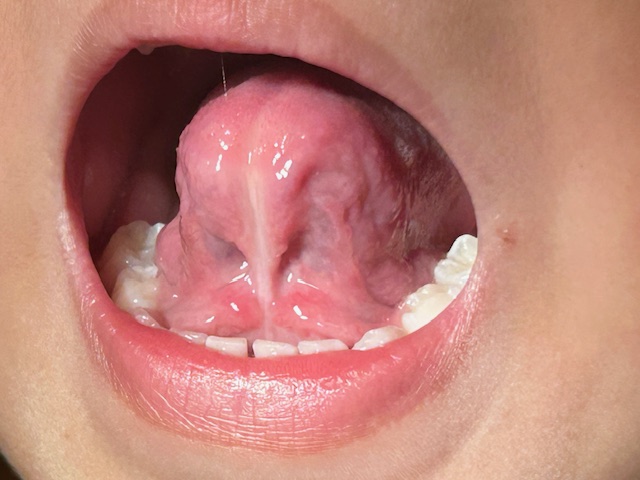
Figure 1
5-year-old boy with an untreated lingual frenulum whose mother took folic acid before conception and during the first trimester.
5. CONCLUSION
Maternal peri- and postconceptional folic acid supplementation is strongly associated with ankyloglossia in this cohort. Findings suggest a potential influence on midline tissue development, warranting further prospective investigation.
6. ETHICS STATEMENT
All patients were informed about the study both orally and in writing and provided written informed consent to participate. The study was conducted in accordance with the principles of the Declaration of Helsinki and was approved by the Ethics Committee of the Hochschule Zurich, in Zurich, Switzerland.
7. CONFLICTS OF INTEREST
The authors have no financial conflicts of interest.
References
[1] Anderson OS, et al. Environmental influences on epigenetic regulation. Environ Mol Mutagen. 2012;53(1):8–21.
[2] Bailey LB, Ayling JE. The extremely important role of folate in human health. Adv Nutr. 2015;6(6):673–684.
[3] Buryk M, et al. Efficacy of neonatal release of ankyloglossia: a randomized trial. Pediatrics. 2011;128(2):280–288.
[4] Czeizel AE, Dudas I. Prevention of the first occurrence of neural-tube defects by periconceptional vitamin supplementation. N Engl J Med. 1992;327(26):1832–1835.
[5] Douglas PS. Rethinking “failure to thrive” in infants. Int Breastfeed J. 2020;15:26.
[6] Geddes DT, et al. Tongue movement and intra-oral vacuum in breastfeeding infants. Pediatrics. 2008;122(1):e188–e194.
[7] Hediger MA, et al. The biology of human lactation. Swiss Med Wkly. 2021;151:w30041.
[8] Messner AH, Lalakea ML. Ankyloglossia: controversies in management. Int J Pediatr Otorhinolaryngol. 2000;54(2–3):123–131.
[9] O’Shea RM, et al. Frenotomy for tongue-tie in newborn infants. Int J Pediatr Otorhinolaryngol. 2021;145:110682.
[10] Parada C, Chai Y. Mandibular and oral development. Development. 2015;142(21):3670–3680.
[11] Sittig LJ, et al. Developmental epigenetics and neurodevelopmental disorders. Dev Neurosci. 2020;42(1):1–14.
[12] Walsh J, et al. Association of ankyloglossia with breastfeeding difficulties. Pediatrics. 2017;139(2):e20163194.
[13] Walsh J, et al. Prevalence and management of ankyloglossia. JAMA Pediatr. 2017;171(10):e1711.
[14] Yoshida M, et al. Environmental factors and craniofacial development. Birth Defects Res. 2017;109(4):279–289.